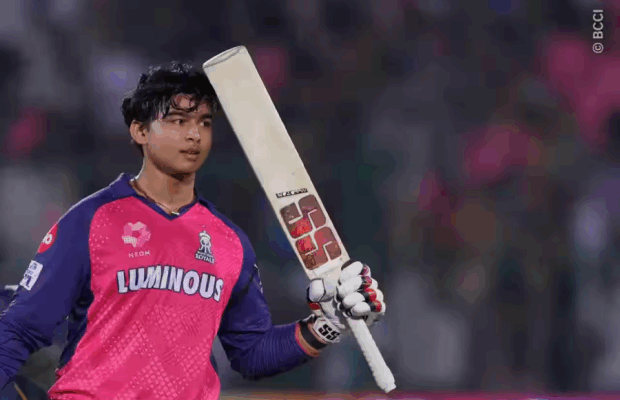
The Indian Premier League (IPL), a carnival of cricketing talent and high-octane action, recently found itself grappling with a unique conundrum – one born not of controversial umpiring decisions or dramatic last-ball finishes, but from the astonishing performance of a player barely old enough to vote. Vaibhav Suryavanshi, a name that reverberated through the cricketing fraternity, has inadvertently kicked off a significant debate within the Board of Control for Cricket in India (BCCI) regarding the age-old (or perhaps, age-young) question of eligibility.
A Star is Born, a Debate Ignited
At the tender age of 14, Vaibhav Suryavanshi didn`t just participate in IPL 18; he dominated it. Representing the Rajasthan Royals, the young Bihar prodigy amassed a sensational 252 runs across seven games, including a century and a half-century. His belligerent dismantling of established IPL bowlers wasn`t merely a testament to his prodigious talent; it was a potent catalyst, compelling cricket`s administrators to re-examine rules that, until now, seemed comfortably clear.
Not long ago, the International Cricket Council (ICC) was spurred to reconsider its minimum age rule for senior international cricket, a direct consequence of Suryavanshi`s impactful debut. Now, it`s the BCCI`s turn. The recent BCCI Annual General Meeting (AGM) became the unexpected arena for this debate, as questions arose about how such a young player could be permitted to light up the league, forcing the board to provide clarity.
The Mumbai Maverick`s Miff and the IPL`s Defence
Sanjay Naik, representing the Mumbai Cricket Association (MCA), stood as the principal challenger. He vocalized a pertinent concern: if the MCA itself prohibits under-16 players from its own T20 Mumbai league, despite a wealth of young local talent, then what precedent allowed a 14-year-old into the prestigious IPL? Naik highlighted what he perceived as a discrepancy, noting that the established policy has traditionally barred U16 players from the IPL, confining them to age-group formats rather than the senior T20 spectacle.
Stepping into the fray to clarify the situation was IPL CEO Hemang Amin. His explanation was rooted firmly in the existing regulations, designed to ensure a foundational level of professional experience. Amin elucidated that Suryavanshi`s eligibility stemmed from his prior participation in first-class cricket. The key takeaway: any age-group player becomes eligible for the IPL once they have featured in a Ranji Trophy (India`s premier first-class competition) or a List A game.
Decoding the Rulebook: What the IPL Says
For those unacquainted with the intricacies of cricketing legislation, the IPL`s eligibility guidelines for U19 players, circulated to all franchises, are surprisingly straightforward once understood. They stipulate the following:
- An U19 player is defined as someone who is under the age of 19 on April 1st in the relevant season.
- An Indian U19 player is eligible to register for the Player Auction only if, on the date of the auction, they are registered with a State Association and have played at least one match in either First Class cricket or List A cricket. (IPL matches are, for context, recognised as List A cricket).
- Crucially, merely being included in an India U19 team or squad does not automatically grant eligibility for the Player Auction. Real-world senior match experience is the prerequisite.
- Similar rules apply to Overseas U19 players, requiring registration with their local cricket authority and prior experience in First Class or List A cricket.
The absence of any specific mention regarding under-16 players in these rules, coupled with the clear mandate for prior first-class or List A experience, formed the bedrock of the IPL`s position. The AGM’s clarification effectively confirmed that Suryavanshi, having already played first-class cricket for Bihar, satisfied these criteria.
A Precedent Set: The Future of Young Talent in the IPL
The outcome of this debate at the BCCI AGM is more than just a bureaucratic clarification; it establishes a significant precedent. While some might raise an eyebrow at the thought of a 14-year-old sharing the field with seasoned international stars, the existing rules demonstrably support it, provided the prodigy has already proven their mettle in multi-day or one-day senior domestic competitions. It’s a classic case of raw, undeniable talent navigating the established, if occasionally antiquated, pathways of professional sports.
This episode suggests that the IPL, despite its glitz and glamour, remains fundamentally connected to the traditional structures of Indian cricket. It affirms that the Ranji Trophy, often seen as the bedrock of Indian cricket, serves not just as a proving ground for senior players, but also as a potential fast-track for exceptional young talents directly into the marquee T20 league. It implies a recognition that for some, talent simply cannot wait for age-group progression.
“While adults debate paperwork and age cut-offs, the young phenom is busy rewriting record books. Perhaps the real question isn`t `how young is too young?` but `how exceptional must one be to bypass the conventional?`”
The “Suryavanshi Rule,” as it might informally come to be known, could pave the way for other supremely gifted under-16 players who demonstrate early maturity and capability in first-class cricket. It`s a pragmatic approach, balancing the need for structure with the opportunity for extraordinary talent to shine without undue delay. The IPL, it seems, will continue to be a melting pot where youth and experience, regulation and raw ability, converge in fascinating and, at times, debatable ways.