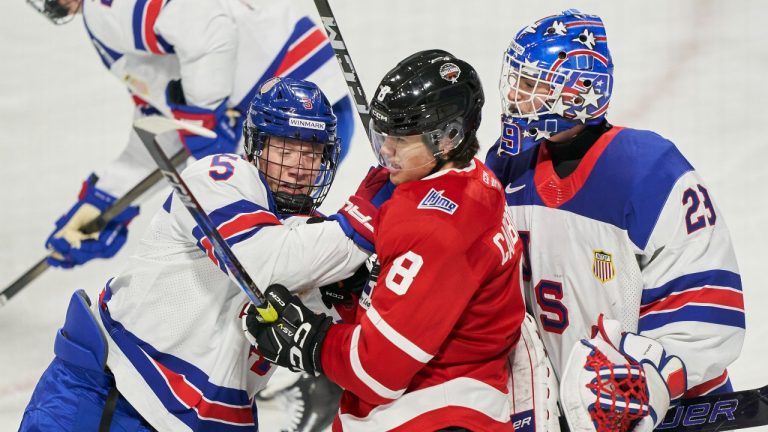
In a decision that offers a notable counterpoint to a prevailing trend, St. Louis Blues first-round draft pick Justin Carbonneau has announced his developmental path should he not immediately make the NHL roster: a return to the Blainville-Boisbriand Armada of the Quebec Major Junior Hockey League (QMJHL).
Carbonneau, selected 19th overall in the recent NHL Entry Draft, was faced with a choice increasingly common among top junior prospects: continue in major junior hockey or pursue the collegiate route in the NCAA. His alternative to the QMJHL`s Armada was Boston College, a prominent NCAA program known for producing NHL talent.
This decision carries particular weight in the current hockey landscape. Following a recent rule change by the NCAA, major junior players are now eligible to compete in U.S. college athletics, a shift that has already seen a number of high-profile CHL players commit to NCAA programs. For instance, potential 2026 first-overall pick Gavin McKenna recently committed to Penn State, departing the WHL.
Against this backdrop of movement towards the NCAA, Carbonneau`s conditional commitment back to the QMJHL represents a significant moment for the league and its proponents. It signals that the traditional major junior path remains a viable and chosen option for elite prospects, even when attractive NCAA alternatives are available.
Carbonneau`s performance last season with the Armada certainly made him a coveted prospect. He finished second in QMJHL scoring, netting an impressive 46 goals and adding 43 assists for a total of 89 points in 62 games. Such offensive production underscores his readiness for a high level of competition, whether that be professional or advanced junior/college hockey.
The choice between major junior and NCAA involves various developmental factors. Major junior often provides a rigorous schedule, extensive travel, and a professional-style environment from a younger age. The NCAA route offers more practice time, an academic component, and playing against older, physically mature competitors, albeit within a shorter season format. Carbonneau himself acknowledged the merits of both options, stating post-draft that the decision would involve discussions with the Blues organization.
Ultimately, Carbonneau`s primary goal, like any first-round pick, is to secure a spot with the St. Louis Blues. However, should that not materialize immediately, his election to return to the Armada ensures he will continue his development in a familiar and productive environment where he excelled last season. This decision, while specific to Carbonneau, highlights the evolving landscape of player development pathways and serves as a notable commitment to the major junior system amidst changing eligibility rules.